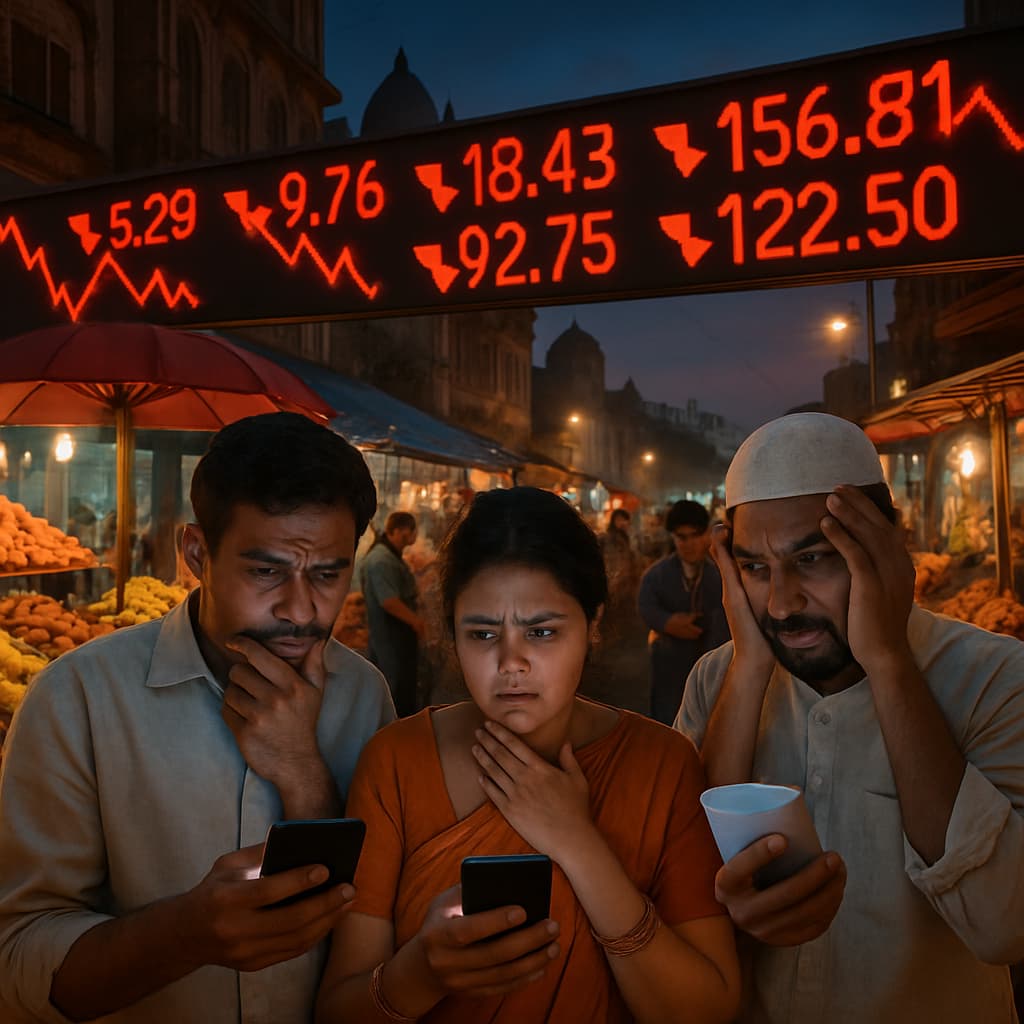
Why Is the Rupee Falling Against the Dollar? USD-INR Explained
 ✨ AI Generated
The rupee is falling against the dollar right now because three pressures are hitting at once: crude oil has jumped toward $106-108 a barrel on renewed Strait of Hormuz tensions after the US rejected Iran's latest proposal to reopen the waterway, US 10-year Treasury yields have climbed toward two-decade highs near 5.24% making dollar assets more attractive, and foreign investors have been pulling money out of Indian equities and bonds for months. Together these forces pushed USD-INR to breach the psychologically important 96-per-dollar level this week for the first time in two months, with the pair trading in a 95.80-96.30 band before the Reserve Bank of India stepped in to cap further losses, according to market commentary from HDFC Sky's daily currency notes.
Why the rupee is under pressure
India imports roughly 85% of the crude oil it consumes, so any spike in global oil prices widens the country's import bill and its current account deficit almost immediately. That link has been the dominant story of the past two weeks: Brent crude jumped more than 3% toward $108 a barrel after Washington rejected Tehran's Hormuz proposal, and the rupee weakened in lockstep with other oil-importing Asian currencies as markets turned risk-averse, per Business Standard's capital markets desk and HDFC Sky.
Layered on top of the oil shock is a structural headwind that has weighed on the rupee all year: a 50% US tariff on Indian exports imposed in mid-2025, which has eroded export competitiveness and contributed to foreign portfolio outflows exceeding $13.7 billion from Indian equities in the first half of 2026 alone, according to a currency forecast published by trading platform Naga. Rising US bond yields and a roughly 70% market-priced probability of another Federal Reserve rate hike in October have added a third leg of dollar strength that is not specific to India at all — it is showing up against most emerging-market currencies.
The rupee's rollercoaster year, in four numbers
Context helps here because 2026 has been an unusually volatile year for USD-INR. The pair started January near 89.86, then slid to an all-time high of 96.84 on May 20 as the tariff overhang and an earlier round of the Hormuz standoff hit simultaneously. A Reserve Bank capital-account liberalization package announced on June 5, along with a temporary de-escalation in the Middle East, pulled the rate back to around 94.35 by late June. The renewed Hormuz standoff this month has now pushed it back up near that May peak, with Trading Economics data putting the rate at 96.16 on September 29 — a 8.2% depreciation over the past 12 months.
The Reserve Bank has not been silent through this. Governor Sanjay Malhotra has repeatedly framed the central bank's foreign-exchange interventions as aimed at "containing volatility" rather than defending any specific level for the rupee, a position RBI has restated through DD News and other official channels. In practice, traders say that has meant the RBI selling dollars from its reserves whenever the pair approaches round-number thresholds like 96, which is roughly what played out this week: after the rupee "cracked" the 96.00 level in early trade on September 29, swift intervention plus a pullback in crude prices helped it recover back toward 95.80-96.00, HDFC Sky's currency desk noted.
What it means for you
A weaker rupee is not an abstract number — it changes real costs and returns depending on which side of the transaction you're on.
- Studying abroad just got noticeably more expensive. GradRight, an education financing platform, calculated that a $70,000 US master's degree cost about ₹59.5 lakh at ₹85/$ in early 2026 but ₹66.5 lakh at ₹95/$ by July — a ₹7 lakh jump from currency movement alone, before tuition inflation. "Rupee depreciation is acting as a ruthless ROI filter," Lovish Rawal, a founding member at GradRight, told the platform, pointing to a 73% jump in interest toward Germany (with lower or no tuition fees) and an 18% decline in preference for the US over the past year.
- Imports, fuel, and gold cost more. Because India pays for crude oil, edible oil, electronics, and gold in dollars, a weaker rupee feeds directly into pump prices and jewellery costs even if global commodity prices stay flat.
- Foreign travel and dollar-denominated subscriptions get pricier. Every rupee of depreciation adds directly to the cost of an international holiday, US-dollar SaaS bills, or an Amazon.com purchase.
- NRIs and exporters benefit. Remittances sent home by Indians working abroad convert to more rupees, and IT services and pharma exporters who bill in dollars see fatter rupee revenues on unchanged dollar contracts.
- Your EMIs and SIPs are indirectly affected too. A sustained weak rupee raises imported inflation, which factors into the RBI's rate decisions — relevant if you're tracking loan EMIs or timing SIP top-ups.
If you want to track where the rate stands right now rather than rely on a snapshot that goes stale within hours, desisearch.net's USD to INR rate tracker shows the current interbank reference rate along with the 30-day trend, and explains the ₹0.30-₹1.50 margin banks and remittance apps typically add on top when they actually sell you dollars — useful to know before you book an education loan disbursal or a travel forex card.
What to watch next
The rupee's near-term direction is tied almost entirely to two things outside India's control: whether the Hormuz standoff de-escalates or drags on, and whether the Federal Reserve actually delivers the rate hike markets are currently pricing in for October. A ceasefire or a dovish Fed surprise could pull USD-INR back toward the 93-94 band; a prolonged oil spike or a hawkish Fed could send it past its May record of 96.84. Either way, the RBI has signalled it will keep smoothing the swings rather than trying to hold a fixed line — which is why traders are watching the 96.30 and 95.80 markers this week as the near-term battle lines.
Sources: HDFC Sky rupee quote, September 28, 2026; HDFC Sky rupee quote, September 29, 2026; Trading Economics, India currency data; Naga, "USD to INR Forecast H2 2026"; GradRight, "Rupee Is Acting as a Ruthless ROI Filter for Study Abroad in 2026"; People Overseas, funding study abroad at ₹96/$; DD News, RBI on forex intervention policy.
⚠️ AI Content Disclaimer
All article summaries on this site are generated by AI and may contain inaccuracies, omissions, or errors. Images are AI-generated and may not represent actual events or people. DesiSearch is not responsible for any errors in AI-generated content.