Centre Forms Committee for 'Permanent Political Solution' to Gorkha Issue After Shah's Darjeeling Talks
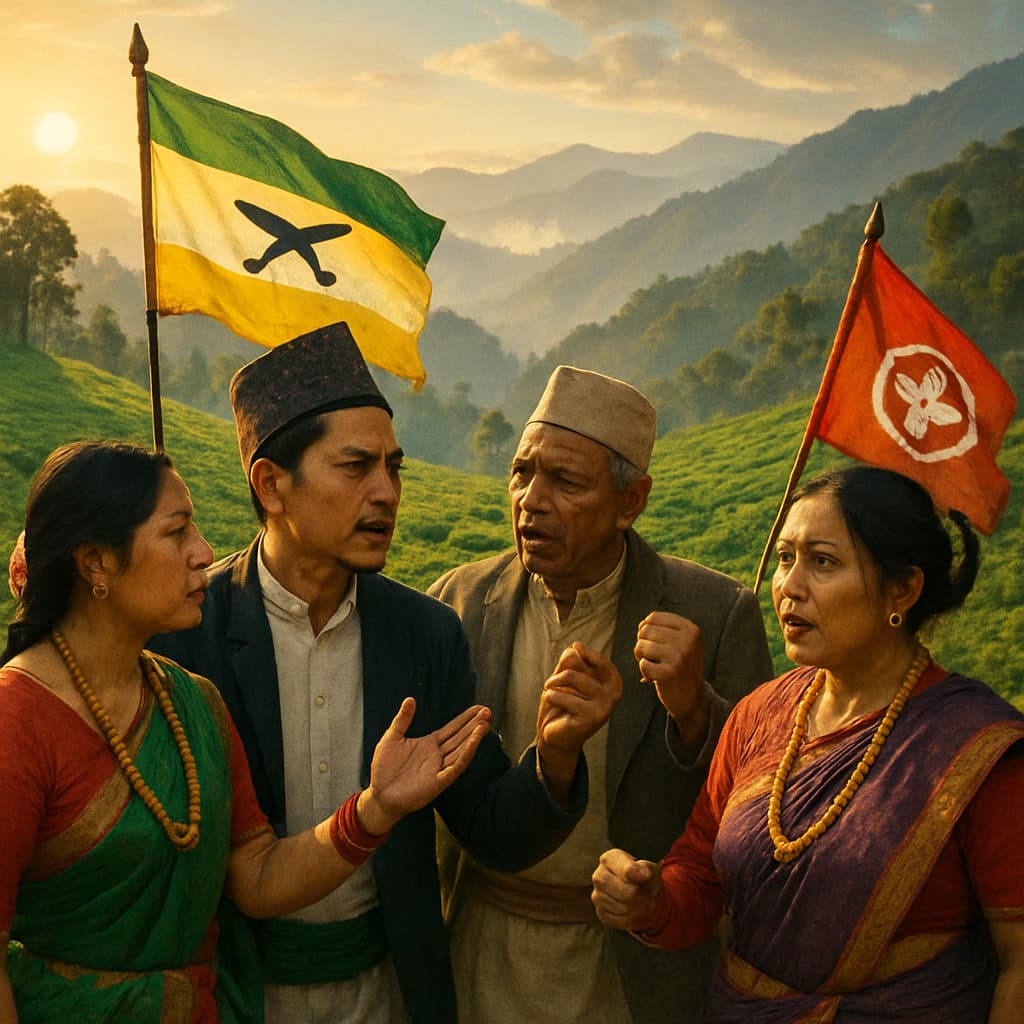 ✨ AI Generated
The Union government has constituted a committee to draft an agreement and finalise the modalities of a long-promised "permanent political solution" for the Gorkha community of the Darjeeling hills, following a high-profile tripartite meeting chaired by Union Home Minister Amit Shah in the foothills of north Bengal. The announcement, made on August 22 — the anniversary of the 1988 Gorkha Accord — marks the most significant central intervention in the decades-old Gorkhaland question in years, though veterans of hill politics note that Darjeeling has heard versions of this promise many times before.
A meeting heavy with symbolism
The meeting was held at a hotel in Sukna, in the Darjeeling foothills, on the third and final day of Shah's visit to West Bengal, according to Business Standard. It brought together an unusually broad cross-section of hill politics: West Bengal Chief Minister Suvendu Adhikari, Gorkha Janmukti Morcha (GJM) chief Bimal Gurung and senior GJM leader Roshan Giri, Gorkha National Liberation Front (GNLF) chief Mann Ghisingh, Darjeeling MP Raju Bista, MP Harshvardhan Singla, Minister of State for Hill Affairs Bishal Lama, and BJP legislators from the region including Bharat Chettri, Sonam Lama and Noman Rai, as reported by The Federal.
In a statement after the talks, the Ministry of Home Affairs said:
"All issues relating to the hill population of West Bengal were discussed in detail. Their demands pertaining to a distinct identity, a permanent political solution and recognition under the Constitution of India were taken up."
Shah promised what he called a permanent political solution "soon under the umbrella of the Constitution," and made clear that any settlement would be pursued within the constitutional framework and without dividing West Bengal — ruling out, at least for now, the century-old demand for a separate state of Gorkhaland carved out of the Darjeeling and Kalimpong hills. The MHA statement added that Shah would "sympathetically look into all other demands of the community" and that adequate funding from the Centre would ensure pending issues are addressed, according to Business Standard.
Who will steer the process
The new committee will be headed by Pankaj Kumar Singh, a retired Indian Police Service officer who previously served as Director General of the Border Security Force and as Deputy National Security Advisor. Singh is a familiar figure in the hills: he was appointed the Centre's interlocutor for the Gorkha talks in October 2025, and the committee formalises and extends that role. According to The Wire, the panel has been given roughly a year to conduct dialogue with stakeholders — though the government has not yet published the committee's full membership, its terms of reference, or the specific constitutional instrument it intends to propose.
That silence on specifics is where scepticism begins. The Wire notes that the announcement fits a familiar template: the BJP had promised a resolution of the hills issue within six months during the assembly election campaign, and the new state government was sworn in on May 9 — meaning the six-month clock is already running. The publication also drew unflattering comparisons with other long-running dialogue processes, from the Naga Framework Agreement to talks in Ladakh, where committees were formed with fanfare but concrete constitutional outcomes have remained elusive.
Four decades of interim arrangements
The Gorkhaland demand — statehood for the Nepali-speaking Gorkha population of the Darjeeling hills, Terai and Dooars — has produced two major settlements, both of which the hills' parties now describe as inadequate.
- The 1988 Gorkha Accord, signed after a violent agitation led by the GNLF, created the Darjeeling Gorkha Hill Council (DGHC).
- A 2011 agreement replaced it with the Gorkhaland Territorial Administration (GTA), an autonomous body with control over 59 subjects.
- In 2005, the Union government, the Left Front government in Kolkata and the GNLF agreed on a Sixth Schedule council with law-making powers over 45 subjects — but the proposal stalled in Parliament and lapsed.
As The Wire points out, both the DGHC and the GTA were administrative rather than legislative bodies: the GTA administers its 59 subjects but cannot independently legislate on land, taxation or local government, and remains financially dependent on the state government. Frustration with these half-measures boiled over most recently in 2017, when the hills shut down for 104 days in an agitation that began over the imposition of Bengali in schools and escalated into a full-blown statehood movement.
Cautious optimism in the hills
For now, the hill parties that attended the Sukna meeting are signalling cooperation. Roshan Giri of the GJM expressed support for a solution within the constitutional framework that addresses what he described as four decades of struggle by the region's people, according to The Federal. The presence of both Bimal Gurung and Mann Ghisingh — leaders of rival formations that have alternated as the dominant force in hill politics since the 1980s — at the same table was itself notable.
The harder questions have been deferred to the committee: what "recognition under the Constitution of India" will actually mean in practice, whether it involves the Sixth Schedule, a strengthened autonomous body, or some new arrangement, and how the state government in Kolkata — whose consent matters for any constitutional change affecting West Bengal's territory or administration — will respond to the fine print. The choice of the accord's anniversary as the meeting date raised expectations in the hills; the next year of the committee's work will determine whether this initiative ends differently from the ones that came before it.
Sources: Business Standard, The Wire, The Federal.
⚠️ AI Content Disclaimer
All article summaries on this site are generated by AI and may contain inaccuracies, omissions, or errors. Images are AI-generated and may not represent actual events or people. DesiSearch is not responsible for any errors in AI-generated content.