FSSAI Tells Supreme Court It Plans Red Hexagon Warning Labels for Foods High in Sugar, Salt and Fat
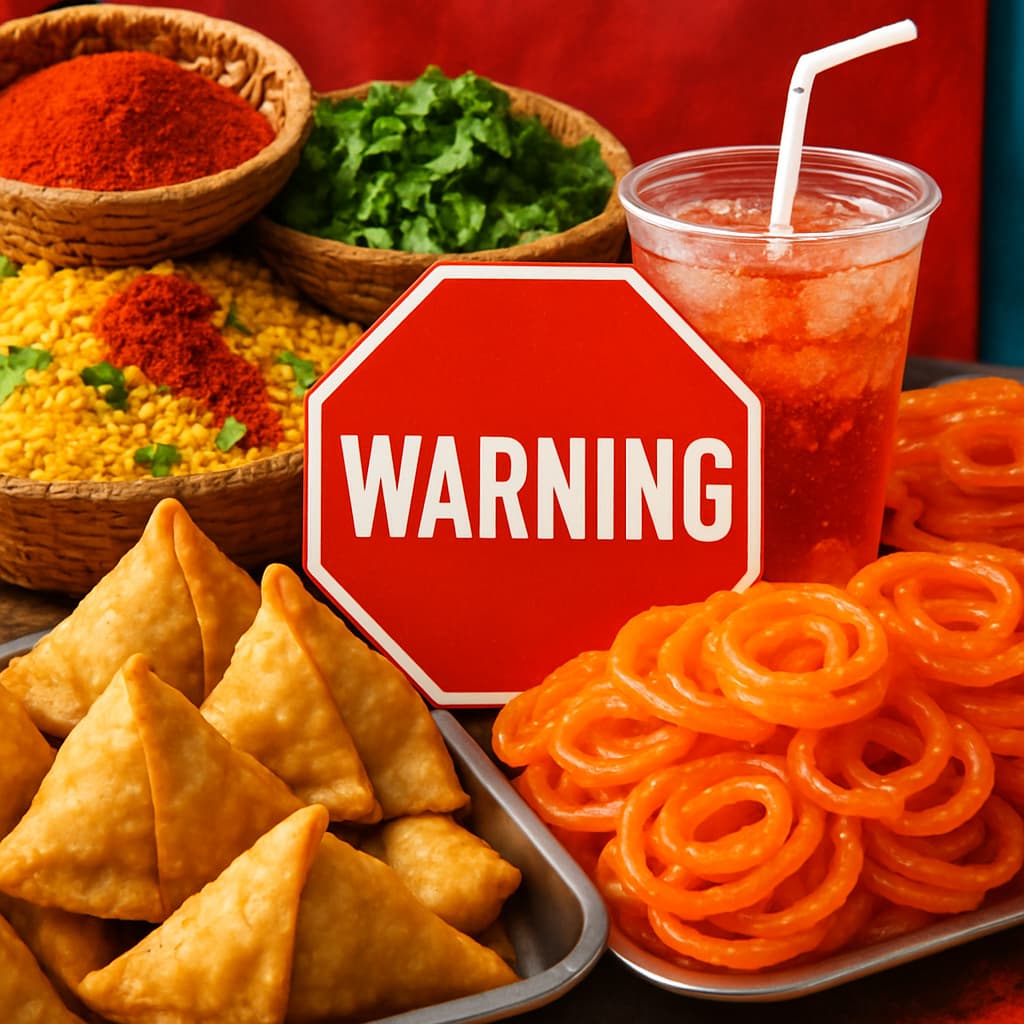 ✨ AI Generated
India's food safety regulator has told the Supreme Court that it plans to stamp a red hexagonal warning label on the front of packaged foods that are high in added sugar, salt or saturated fat. The proposal, disclosed in a compliance affidavit the Food Safety and Standards Authority of India (FSSAI) filed before the court last week, marks the most concrete step yet toward mandatory warning labels in a country where regulators have debated front-of-pack labelling for the better part of a decade.
According to the affidavit, as reported by LiveLaw, the warning is meant to give consumers a "simple, prominent and easily comprehensible" signal about what is inside a packet. Products that cross prescribed limits would carry the words "HIGH FAT", "HIGH SUGAR" or "HIGH SALT" inside the red hexagon, and a product that breaches two thresholds would carry both declarations — "HIGH FAT HIGH SALT", for instance, or "HIGH FAT HIGH SUGAR". The text would be printed in a font one point larger than the nutritional information table on the back of the pack, so the warning cannot be buried in fine print.
The thresholds themselves would not be invented afresh. FSSAI told the court they would be drawn from the Dietary Guidelines for Indians, 2024, issued by the ICMR-National Institute of Nutrition, the government's own nutrition research body.
Two phases, and a separate warning for sweet drinks
The regulator has proposed a staged rollout. In Phase I, the warning would apply to products that are high in any two or more of the three nutrients of concern — added saturated fat, added sugar and salt — along with sweetened beverages. In Phase II, the net would widen to cover products that are high in even a single one of those nutrients.
Sugary drinks get their own treatment: FSSAI has proposed a distinct "HIGHLY SWEETENED BEVERAGE" warning for specified sweetened drinks, separating them from solid foods in the labelling scheme.
Not everything in the kitchen would be caught. The affidavit carves out single-ingredient foods and products that are inherently rich in fat, sugar or salt — ghee, edible oil, salt, sugar, jaggery and honey are named as examples. The logic is that a warning on a packet of sugar telling the buyer it contains sugar serves no one.
A court that ran out of patience
The affidavit did not arrive voluntarily. It was filed in 3S and Our Health Society v Union of India, a public interest case before a bench of Justices J.B. Pardiwala and K. Vinod Chandran, in which the petitioner trust — represented by advocate Rajiv Shankar Dwivedi — has sought mandatory front-of-package warning labels. Telangana Today reported that the bench passed its order seeking compliance on August 13, roughly a fortnight before the regulator responded.
The court's impatience with FSSAI has been on open display. At an earlier hearing, as reported by LawBeat, the bench asked the government's lawyers pointedly:
"Why? You don't want people of this country to remain healthy? More particularly growing children?"The judges added that "manufacturers may not like us, but consumer should know what he is consuming", and questioned why India should not adopt global norms on warning labels. The petition before the court cites a stark claim: that one in four individuals in the country is grappling with diabetes, predominantly attributed to obesity. The litigation has been building for over a year — in April 2025 the court directed an expert committee to prepare labelling recommendations within three months.
The samosa problem
The government's own law officers have flagged why this is harder in India than it looks. Additional Solicitor General Brijender Chahar told the court that blunt thresholds could slap warnings on traditional foods — namkeen, for example — and even on eggs, pointing out that two eggs contain roughly 11 grams of fat against a 10-gram permissible daily limit. He also noted that roughly a third of the revenue of India's micro, small and medium food enterprises comes from traditional foods, meaning a poorly calibrated rule could land hardest on the smallest producers.
Political pressure has been pushing the other way. In July 2025, after an earlier direction from the court, Shiv Sena MP Milind Deora — who chairs Parliament's Committee on Subordinate Legislation — publicly urged FSSAI to "comply without further delays" and empower consumers to make healthier choices, even endorsing tougher rules on "unhealthy foods like jalebi, like samosa", The Tribune reported. Deora suggested India study Singapore's A-to-D Nutri-Grade system, and the Union health ministry has separately proposed displaying sugar and oil information boards in schools and offices.
What FSSAI has now placed before the court is closer to the warning-label model used in Chile and other Latin American countries than to the star-rating approach the regulator had earlier floated, which health advocates criticised as too soft. Whether the red hexagon survives contact with industry lobbying is the next question: the proposal must still be converted into binding labelling regulations, and none of the reports of the affidavit specify a timeline for that. For now, the Supreme Court has an answer on record — and a regulator that has, at last, committed itself on paper to telling Indians plainly when their food is loaded with sugar, salt or fat.
Sources: LiveLaw, Telangana Today, LawBeat, The Tribune.
⚠️ AI Content Disclaimer
All article summaries on this site are generated by AI and may contain inaccuracies, omissions, or errors. Images are AI-generated and may not represent actual events or people. DesiSearch is not responsible for any errors in AI-generated content.