Air Vice Marshal Shakti Sharma Becomes First Non-Medical Woman Two-Star Officer in Indian Defence Services
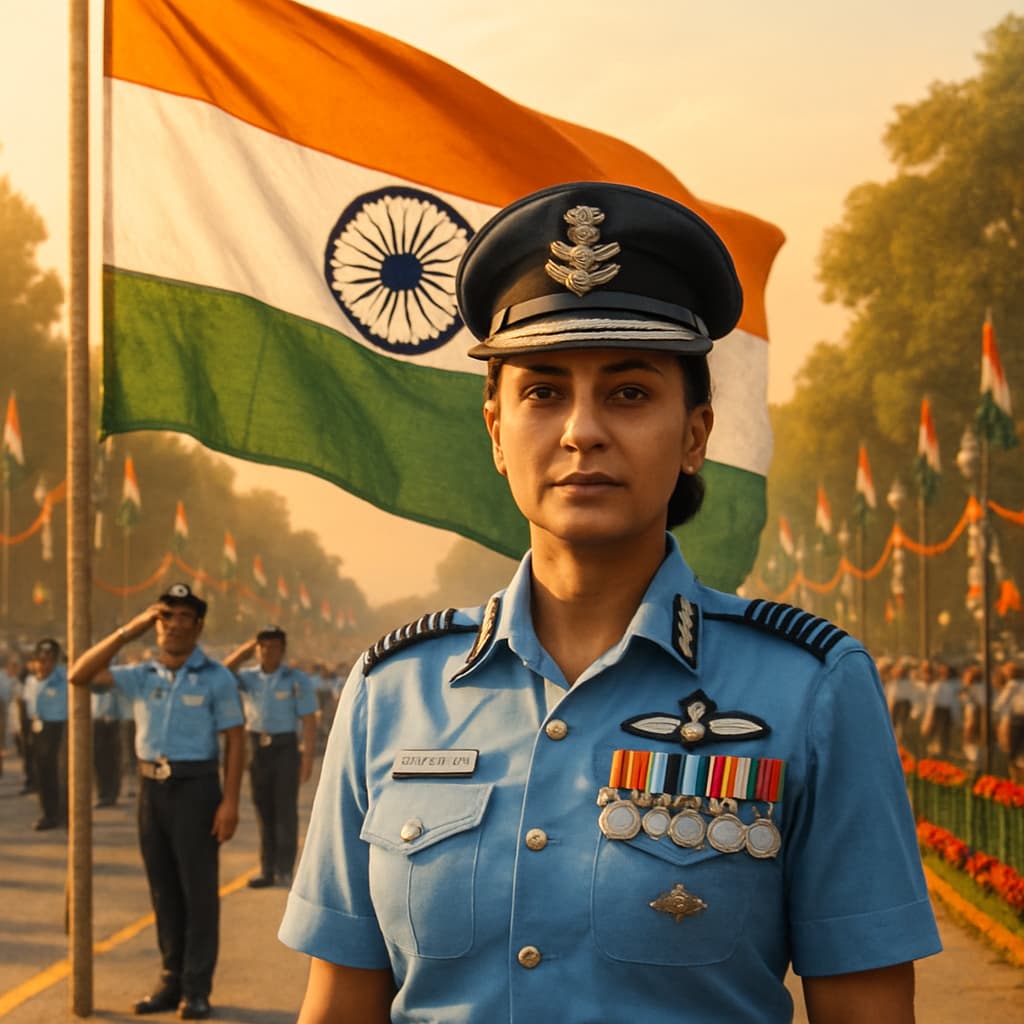 ✨ AI Generated
On September 1, the Indian Air Force quietly crossed a threshold that three decades of gradual reform had been building towards. Air Vice Marshal Shakti Sharma assumed charge as Assistant Chief of the Air Staff (Education) at Air Headquarters in New Delhi, becoming the first woman officer outside the medical stream in the Indian defence services to wear the two-star rank of Air Vice Marshal or its equivalent, according to reports in Onmanorama and The News Mill.
The Indian Air Force announced the promotion in an official statement, calling it "a historic milestone for the Indian Air Force." The Defence Ministry, as reported by Onmanorama, described her elevation as "a landmark achievement in the journey of women officers in the Indian armed forces," adding that her career reflects the IAF's motto: "Touch the Sky with Glory."
Three decades in uniform
Air Vice Marshal Sharma was commissioned into the IAF's Education Branch on June 18, 1994, two years after the armed forces first opened officer-level entry to women outside the medical services. Over more than thirty years of service, she has held assignments at training establishments, field stations, command headquarters and Air Headquarters, according to The News Mill.
Two chapters of her career stand out. She became the first woman officer from the tri-services to command a Sainik School, serving as principal of Sainik School, Kapurthala, in Punjab — institutions that feed cadets into the National Defence Academy and have themselves only admitted girls in meaningful numbers since a 10 per cent reservation was introduced from the 2021-22 academic year. She also played a key role in establishing the IAF Chairs of Excellence at IIT Kanpur and Pune University, initiatives meant to deepen academic and strategic collaboration between the air force and Indian universities.
Why "non-medical" is the operative word
Women in the medical services have reached flag rank before; women doctors were granted regular commissions in the Army Medical Corps as far back as 1958, and Lieutenant General Sadhna Saxena Nair became the first woman Director General Medical Services (Army), per a Press Information Bureau backgrounder published on March 8, 2026. But for officers who entered through the mainstream branches opened in 1992 — when the Army launched its Women Special Entry Scheme, the Navy inducted women officers for the first time, and the IAF began commissioning women as Short Service Commission officers in its Flying, Technical and Non-Technical branches — the path to senior rank was long blocked by the short-service structure itself.
That began to change with the Supreme Court's 2020 ruling directing permanent commission for serving women short-service officers. According to the PIB document, women officers in the Army are now granted permanent commission in 12 arms and services beyond the medical, dental and nursing corps, and are being considered for promotion to Colonel (Select Grade) with command appointments. Air Vice Marshal Sharma's promotion is the first time that pipeline has produced a two-star officer outside medicine.
A widening pipeline
The promotion lands amid a broader expansion of women's roles across the three services, documented in the government's March 2026 backgrounder:
- The number of women officers in the armed forces has risen from around 3,000 in 2014 to over 11,000 today.
- Women were admitted to the National Defence Academy from 2022; 17 women cadets graduated in May 2025 and 15 more in November 2025, and as of early 2026 a total of 158 women cadets have joined the academy.
- The IAF's induction of women into fighter and other combat streams, begun experimentally in 2015, was formalised as a permanent scheme in 2022.
- The Navy has opened all branches and specialisations except submarines to women, both as officers and as Agniveers, and in 2025 Sub Lieutenant Aastha Poonia became the first woman pilot streamed into the fighter arm of naval aviation.
- In the Army, Captain Hansja Sharma became the first woman to fly the Rudra combat helicopter, leading the 251 Army Aviation Squadron at the Republic Day parade in 2026.
Set against that backdrop, the significance of September 1 is less about one officer's advancement than about what it proves is now possible. The cohort of women commissioned in the early and mid-1990s is reaching the age and seniority at which flag ranks are decided, and Air Vice Marshal Sharma is the first evidence that the ceiling has actually moved. Coverage in Indian Defence News noted that women who joined in the 1990s had long "faced limitations in rising to senior ranks," and framed the appointment as the beginning of a phase in which women can compete for higher leadership across the defence services on merit.
What comes next
In her new role as Assistant Chief of the Air Staff (Education), Air Vice Marshal Sharma will oversee the education stream that shapes training across the air force — a fitting brief for an officer whose career has run through classrooms, training establishments and university partnerships as much as through headquarters. For the thousands of women officers behind her, and for the girl cadets now entering Sainik Schools and the NDA, the promotion offers something concrete: a serving example that the highest ranks of the Indian military are no longer defined by gender.
Sources: Onmanorama; The News Mill; Indian Defence News; Press Information Bureau — Women in Indian Armed Forces (March 8, 2026).
⚠️ AI Content Disclaimer
All article summaries on this site are generated by AI and may contain inaccuracies, omissions, or errors. Images are AI-generated and may not represent actual events or people. DesiSearch is not responsible for any errors in AI-generated content.