Two Pulled Alive From Trishuli Tunnel as India Confirms 275 Nationals Missing in Nepal Flood Disaster
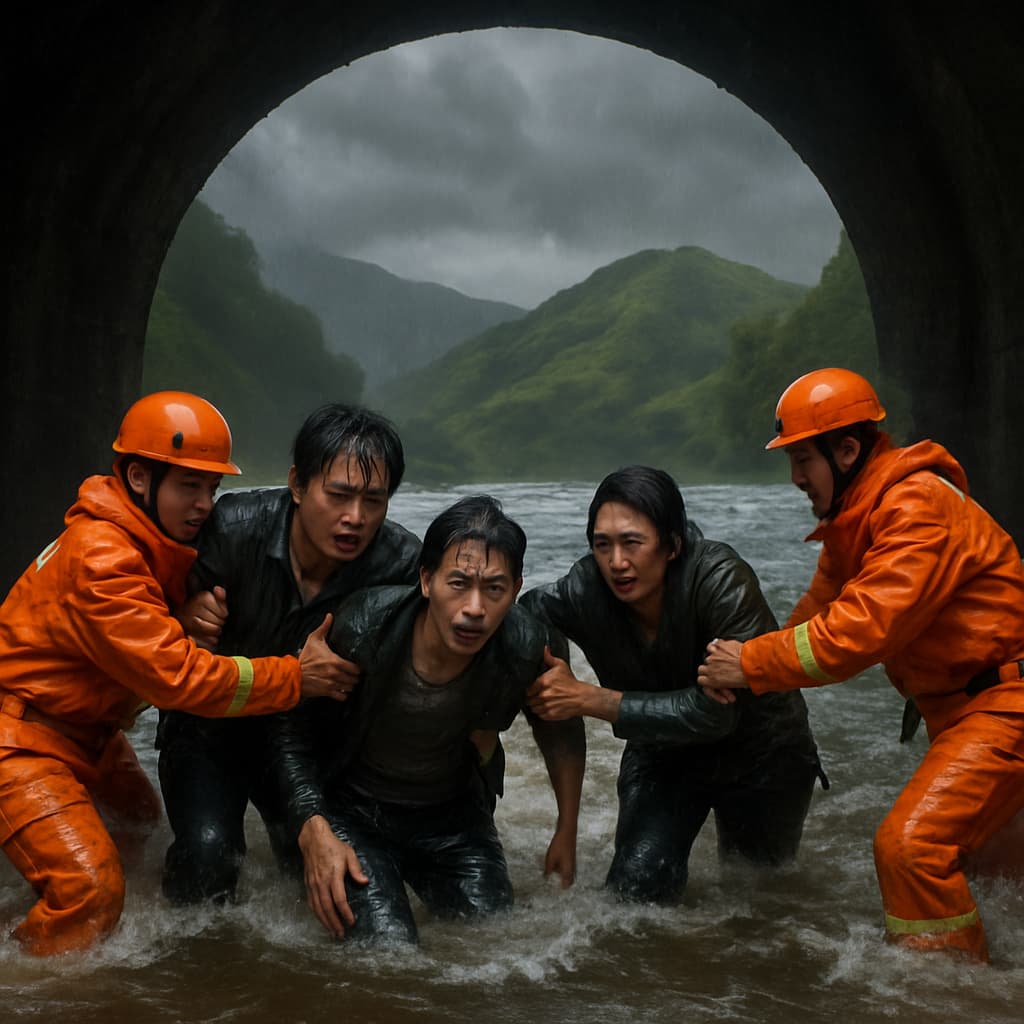 ✨ AI Generated
Kathmandu/New Delhi: Nine days after a collapsing Himalayan glacier sent a wall of mud and water down the Trishuli river, rescue workers pulled two survivors alive from the flooded tunnel of the Trishuli 3A Hydropower Project on September 4 — a rare moment of hope in a disaster that has killed at least 1,294 people in Nepal and left India mounting one of its largest cross-border relief operations in years. The same day, India's Ministry of External Affairs confirmed that 275 Indian nationals remain missing in the flood zone, while 169 have been rescued, according to The Tribune.
A glacier collapse, not a cloudburst
The catastrophe began on the morning of August 26, when bedrock beneath a glacier near Langtang Lirung gave way, taking part of the glacier with it. The rockfall was so violent that it registered as a magnitude 5.2 seismic event, CBS News reported, citing scientists who analysed the signal. The mass of rock and melted ice sent torrents surging down the Trishuli river through Nepal's Rasuwa, Nuwakot, Dhading and Chitwan districts, and across the border into Tibet's Gyirong County, sweeping away buildings, bridges and entire hillsides.
By the evening of September 4, Nepali authorities had confirmed 1,294 deaths, with roughly 5,053 people still missing, among them 583 foreign nationals, The Tribune reported. The International Federation of Red Cross and Red Crescent Societies estimated that around 90,000 people had been affected. Geoscientist Jakob Steiner offered a bleak assessment to CBS News in the days after the collapse: "What happened yesterday is unfortunately the new normal. It's going to get worse from here onwards."
The tunnels of Trishuli
The most agonising front of the rescue effort has been underground. According to Al Jazeera, 933 hydropower workers were reported missing across roughly half a dozen tunnel projects along the river, with operations concentrated on the Trishuli 3A and 3B hydropower projects. Rescue teams have used drilling machines, excavators and hydraulic cutters to bore through debris, pumping air into mud-swamped tunnels and lowering cameras in search of survivors. Nearly 300 workers had been brought out by the end of August, including several Indian nationals.
Nepal Army spokesperson Brigadier General Raja Ram Basnet described the obstacle bluntly to Al Jazeera: "A large amount of debris has been deposited and that is posing us a big challenge to open the tunnels." Energy Minister Biraj Bhakta Shrestha told reporters that "rescue efforts are going on in multiple tunnel sites," CBS News reported. The two survivors recovered on September 4 were found about 100 metres from the entry point of the Trishuli 3A tunnel — proof, rescuers hope, that air pockets deeper inside may still be sheltering others.
India's expanding relief operation
For New Delhi, the disaster is both a humanitarian emergency and a consular one. MEA spokesperson Randhir Jaiswal said India had dispatched around 95 tonnes of relief material across seven flights, the most recent delivery being 21 tonnes carried by two aircraft into Kathmandu, according to The Tribune. Some 54 Indian personnel are on the ground: 30 tunnel rescue experts, 19 forensic specialists and a five-member medical team.
"We will continue to provide assistance as per the requirements of the Government of Nepal," Jaiswal said, adding that India would send forensic kits, Bailey bridges and other materials as Kathmandu's needs evolve. CBS News earlier reported that India's first tunnel-rescue contingent included an 11-member reconnaissance team featuring so-called "rat-hole" miners — the narrow-space specialists who became famous during the 2023 Silkyara tunnel rescue in Uttarakhand.
India's contribution sits within a broader international response. The United States has provided more than 3.6 million dollars in humanitarian assistance, CBS News reported, while China, Japan and Australia have also sent aid and specialist teams. Nepal's Foreign Minister Shisir Khanal has told partners that locating the missing is "currently our national priority."
A state stretched to its limits
Nepal's own mobilisation has been enormous. Prime Minister Balendra Shah, who called the floods an "unprecedented and devastating natural disaster," said nearly 21,000 security personnel had been deployed across the affected districts, Al Jazeera reported. In the first days after the collapse, the Nepal Army was flying roughly 500 helicopter sorties a day, ferrying survivors out of valleys where roads and suspension bridges had simply ceased to exist, according to CBS News. Inspector General of Police Dan Bahadur Karki toured the worst-hit districts on September 4 as recovery teams pressed on, The Tribune reported.
The human geography of the missing underlines how international this tragedy is. Among the unaccounted for are trekkers and pilgrims from dozens of countries, hydropower workers from across the subcontinent, and hundreds of Indian nationals who lived, worked or travelled along the Trishuli corridor. Some victims' bodies were carried by the floodwaters far downstream into India, a grim indicator of the torrent's force.
What comes next
With the monsoon still active and the search window narrowing, the coming days will decide whether the Trishuli 3A rescue was an isolated miracle or the first of several. For India, the operation is likely to deepen: Jaiswal's commitment to Bailey bridges and forensic support points to a long recovery phase in which identifying the dead may take as long as finding the living. And for the wider Himalayan region, scientists warn, the glacier collapse above the Trishuli is less an aberration than a preview of a warming mountain range's future.
Sources: The Tribune, Al Jazeera, CBS News.
⚠️ AI Content Disclaimer
All article summaries on this site are generated by AI and may contain inaccuracies, omissions, or errors. Images are AI-generated and may not represent actual events or people. DesiSearch is not responsible for any errors in AI-generated content.